Thursday, November 26, 2009

Turntable Plans and Photos


As promised, these are the plans and photos showing how I constructed and installed my hand-operated turntable. I want to stress that none of this comes from any idea of mine; as mentioned in a previous post, this setup is based on a 1951 Model Railroader article. Likewise, the wiring scheme comes from an installment of the"From Pillar To Post" series that ran in the same magazine in 1949.
Photos 1, 2
These plans are pretty self-explanatory. The only thing I'd point out is that my particular turntable design is based on prototypes where the pit rail wheels at each end of the turntable are all but concealed under the turntable bridge structure. I at first considered adding the wheels, but since they wouldn't really be visible, I left them off for simplicity's sake.
Photo 3
Underside of the control disk, which was cut from a piece of particleboard.
Photos 4, 5
Overall views of the turntable, approach track, and the three roundhouse tracks, each of which are independently powered.
Photo 6
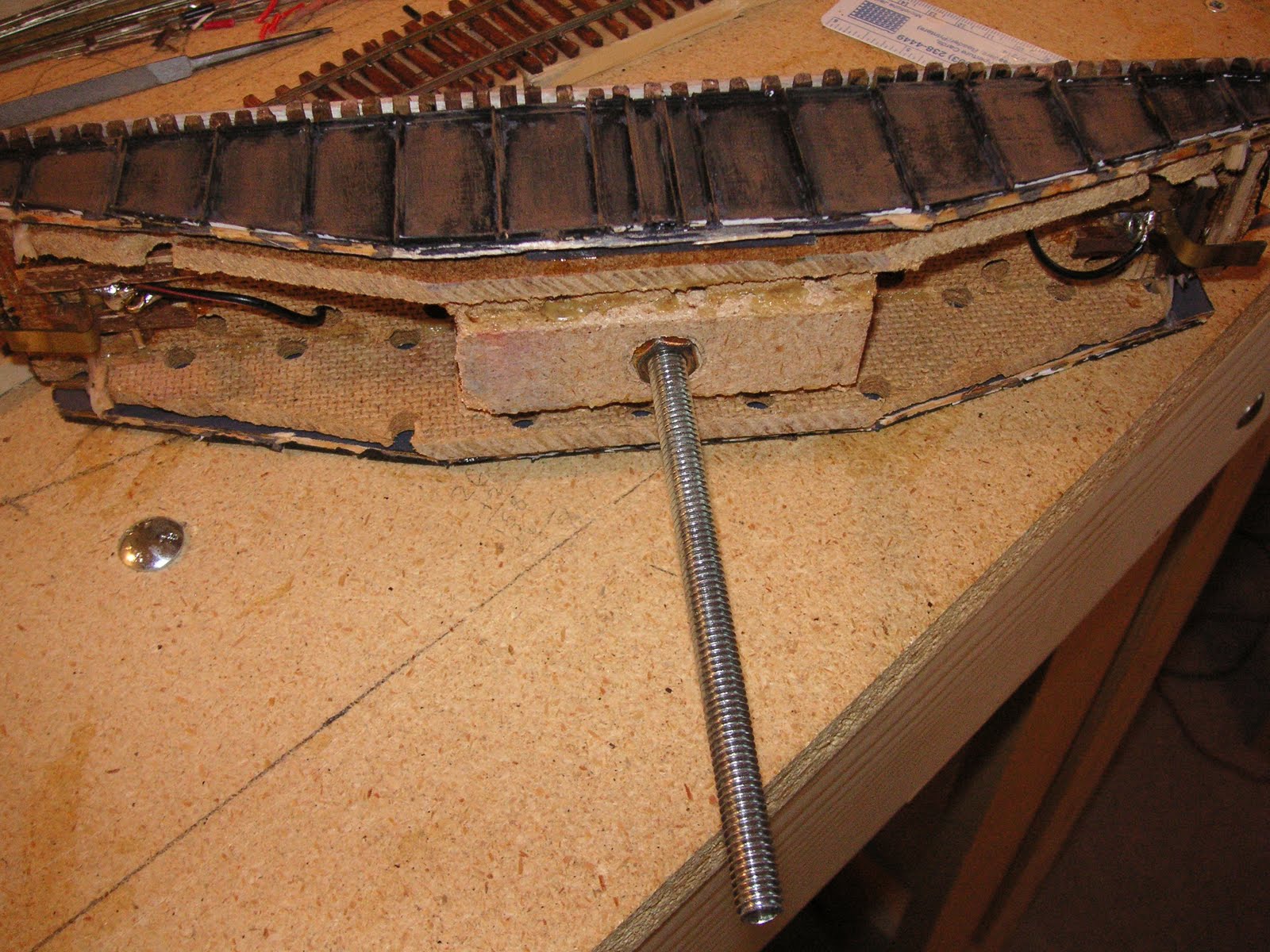
Underside of the turntable pit.
Photo 7
The turntable bridge.
Photo 8
Closeup of the wiper, constructed from 1/4 inch-wide brass, and bent to provide a "spring" effect to ensure good contact with the pit rail.
Photo 9
Pit rail, including one of the gaps; the gaps will later be filled by small pieces of rail glued into place. The coating of glue will act as insulation.*
Photo 10
This is an "armstrong" turntable, plausibly still in use in 1947 since it serves only a small, three-stall roundhouse.
*Nov. 29 note: I wound up using small pieces of rail-sized stripwood to ensure the gaps remained insulated...safer than using rail, even with the glue.


Our Dog

The last couple of weeks have been pretty difficult for Susie and me. Our 13-1/2 year old dog, Daisy, suddenly developed severe, very painful spinal problems and, though our veterinarian did all she possibly could, our only reasonable and humane course was to end her terrible suffering and have Daisy put to sleep.

Daisy was a 9 lb. mix of poodle, Lhasa Apso, Yorkshire, and Pomeranian. She was the kind of dog everybody immediately liked...very friendly, extremely intelligent, well-behaved and loyal. She got along well with other dogs and, especially, with cats.

I have had a lot of pets...cats and dogs...in my 62 years, but she was the very best. Daisy, like many dogs, loved to ride in the car. She went everywhere with us and had been in least two dozen states. We got Daisy when we lived in Portland, Oregon, when she was 6 weeks old. She was an important, much-loved member of our family.

Thanksgiving

My family and I have much to be thankful for this Thanksgiving. We are all in good health and are doing well in every aspect of our lives. We have been blessed repeatedly and abundantly and we are all grateful to God.

I'm especially thankful that we all live close by one another, which is pretty remarkable considering none of us are originally from Texas. Our two daughters' husbands each were offered jobs here in early 2008; at their urging we moved here, too, and we're glad we did. I don't think our gathering here is a coincidence, and I'm grateful to God for that, too.

Tuesday, November 3, 2009

Turntable Progress

I've begun installing the turntable, which consists of essentially putting it back together after months in storage. The pit rail is in and I'm doing a little refurbishing on the bridge, including new decking and some paint touchup. I'll have step-by-step progress photos in my next post.

I just returned from a visit to the local hobby shop. I'm laying in some supplies for projects that will be coming up soon, such as plastic brick sheeting, which will be used for my new depot and for a partial rebuilding of my roundhouse. I was satisfied with the roundhouse when I built it, but I think it can be improved.

I'm also stocking up on paint. In recent years I've switched entirely from oil-based to water-based "railroad" paints. I like the lack of odor and easy cleanup with water-based paint and the ability to mix the railroad paints with other acrylics. My local hobby shop has only some oil-based paint on hand, but was happy to order the water-based I want.

I had an interesting conversation with the hobby shop man, who said he seldom gets a request for paint or other scratchbuilding supplies these days. He thinks the craft of building models from kits is disappearing, along with scratchbuilding. He said many younger hobbyists seem baffled at the very idea. My son-in-law Craig, who is in his 30s and who does scratch and kit building of aircraft and ships, has noticed the same trend in that type of modeling.

It's a hobby, so to each his own, but I get a lot of enjoyment out of building. I find it relaxing. I get completely absorbed, and I don't care how long it takes. I've had projects take days, weeks...a wooden passenger coach actually took years! I kept it in a shoebox and worked on it when I felt like it, and had a great time in the process.

Sunday, October 18, 2009

Darrell's Comment, Part 2

This is in response to Darrell's comment on my response to his August 17 comment (I hope that makes sense!).

First of all, Darrell, I appreciate your observation about eyesight! I wear trifocals, which help with close work, but I still occasionally take off my glasses for really close work; it's one time when being very nearsighted helps!

As far as the use of a ruler in turnout construction, I guess it's more of a double check than anything else, mostly to make sure the gauge throughout the turnout is within tolerance. And, of course, to make sure there's a slight widening of the gauge at the toe of the points, etc. I think I probably take much more time than I need in constructing turnouts, but I will say the result is smooth running, so I guess it's all working out. I've found what really is important is making sure the gauge is proper in the straight sections of the diverging path; that is, at the points and through the frog. I find if I get that right, the curved portion of the diverging stock rail tends to line up accurately.

I so far have built only standard turnouts, with the exception of a curved turnout experiment a couple of layouts ago that was a so-so success. I am considering trying that again...just considering, at this point. If I were really brave, I guess I'd think about a three-way turnout, which I've found intriguing ever since I saw a prototype example in a Portland, Oregon industrial area.

Friday, October 16, 2009

Turntable Reference Articles

The turntable mechanism was designed based on an article in the July 1951 Model Railroader, and the turntable bridge design itself was somewhat of a composite based on a number of plans I've seen, but leaned heavily on an article in the October 1940 Model Railroader. I picked up the 1951 issue at a hobby show, and photocopied the 1940 article from a magazine in the Portland, Oregon main library's archives.

I favored the 1940 turntable bridge design because it's an "armstrong" man-powered turntable, with a push pole, being relatively small.

Wednesday, October 14, 2009

Fun Vs. Fanaticism

A word about my hobby philosophy. First of all, it is a hobby, a pastime. Just that, and no more. It is only one of many things I enjoy. I'm blessed with a wonderful wife; after 36 years of marriage, we're having more fun than ever, and we thoroughly enjoy doing things together. We spend a lot of time with our daughters, sons-in-law, and granddaughters, and we take a number of senior citizens' continuing education classes at the local college. At train shows I have encountered those for whom this hobby is their whole life, and I've seen this in people with other hobbies or interests. That's fine for them, I'm sure, but not for me.

Guess that's why my layout progress is a little unevern, but what the heck...there's no schedule! However, that being said, track construction is going well and should, for this phase of the layout, be finished soon. By "this phase" I mean the "left" and central part of the layout. My plan is to completely finish this portion, including scenery, before moving on to the "right" section which will include the port area. I like running trains, but I also really like working on scenery and structures, and this approach will allow that to happen sooner.

As track is laid I test it with both of my locomotives and make any necessary adjustments which, so far, have been fairly minor. The 0-6-0 is the more demanding of the two engines.

I've also unpacked my turntable, which served well on my Idaho layout. It is manually operated by means of an under-the-table control wheel, based on an article in an early-1950's Model Railroader. I'll provide the exact edition in a future post, since I'm writing this while away from the train room. The turntable style itself is based on an even earlier Model Railroader article. Anyway, I will soon be working on installing it.

It's also time to think about installing a backdrop, but I'm holding off until the December Model Railroader, which will have an article on that subject. I pretty well know what I want, but I think I'll hold off and see if there are any new ideas in that article.